
I like my phone. Sometimes I feel like the only one who does. OpenAI definitely wants to break out of the confines of Google and Apple's rectangles. You could see this clearest in the Dots promo video. As the actors interact with these persistent agents, we see status updates and outputs appear on strange screens on stilts (presumably a visual metaphor) instead of laptops and smartphones.
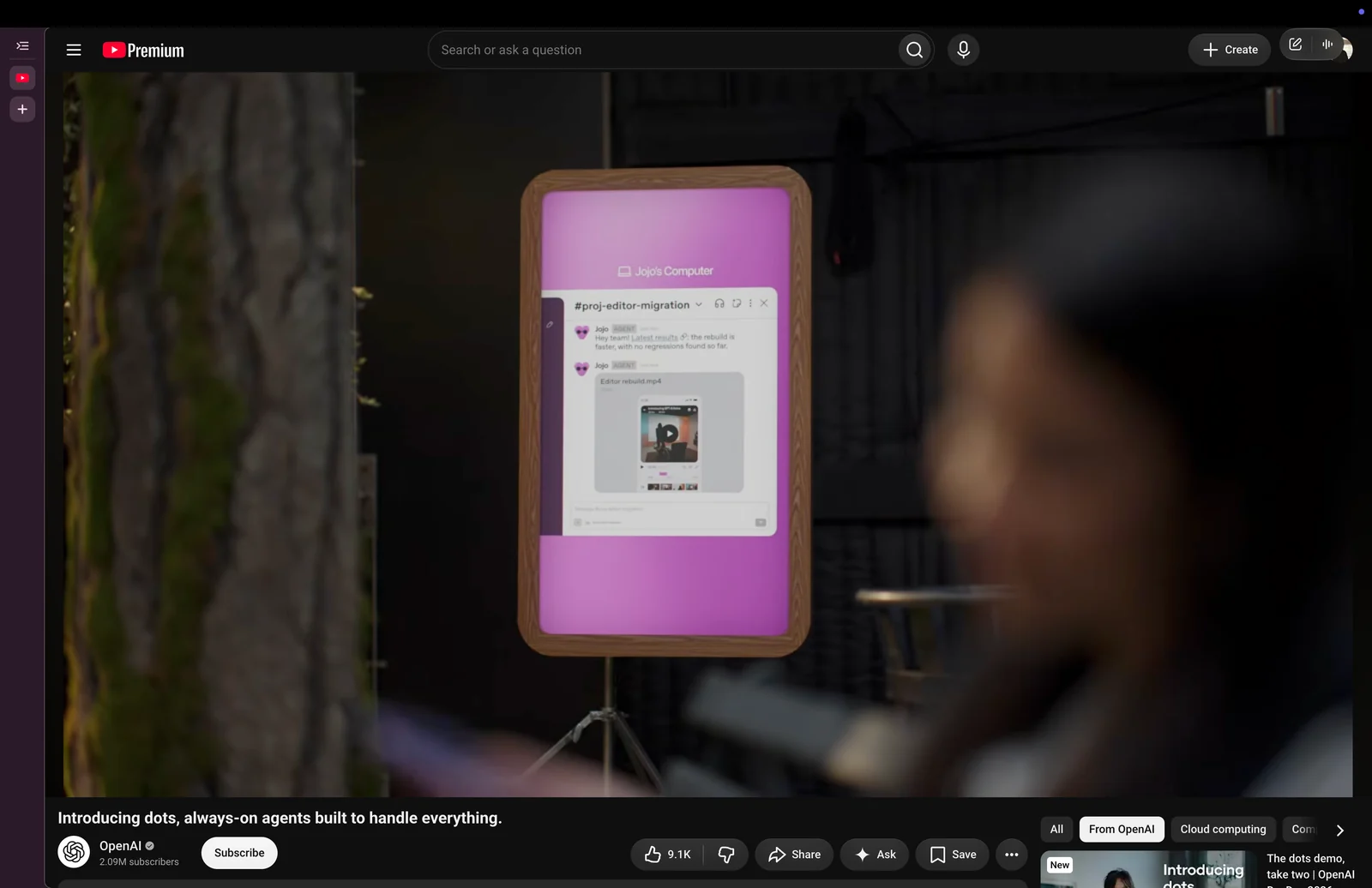
This would have been a great time to showcase the hardware product they're working with Jony Ive on, especially in a year without a radical new device (all due credit to the Duo) from Apple. Meta, meanwhile, took a characteristically aggressive approach with their glasses and pendant (what Ben Thompson calls Muse Delivery Vehicles). Instead of a muscular showing like that, we got a passive-aggressive absence of smartphones.
In my view, Apple already makes the best devices for agents - phones, watches, and earbuds. To be clear I'm one of the weirdos with a sweaty setup involving a Mac mini in my closet, and my daily walk to work is spent triaging the day's work through ChatGPT voice mode. But if this ambient agent paradigm takes off, Apple has a viable fast follow approach through HomePods, iPads, and Apple TVs. This year's DevDay didn't show us how OpenAI would challenge that.
Where AI companies are already very strong is the workplace. As a software engineer able to freely choose the best tools, I usually reaching for Codex. It has the edge in polish and UX, not to mention an easy always-on setup on the aforementioned Mac mini. Some of my clients require me to use Claude Code, though, and it's not too far behind. And Fable 5 is still the smartest model outsiders like me can access.
Coding Agents dominate my current usage, but this has started to change with the recent addition of General Purpose Agents like Muse. I expect to titrate that down in favor of Dots, which are OpenAI's take on those GPAs (I've named mine Del! It's short for Delegate, both for the pun and as a reminder to offload tasks to it). One thing these all have in common? They're products/surfaces from companies that also develop the models themselves. And having access to frontier intelligence doesn't seem to be the cause of the lock-in. Muse Spark is at least slightly below frontier intelligence but that hasn't made the product qualitatively worse than Dots in my experience. I suspect there's a variety of structural forces that will keep products from model companies dominant for quite a while. Even Apple is seemingly subject to this - I simply don't use the new Siri all that much, despite the OS-level integration.
This model company moat has one big exception - Slack. A big surprise to me was how many first party OpenAI features were demo'd through Slack! They had a full blown Notion-killer, but still pulled up Slack in the keynote and in conference sessions. It seems like at the AI labs if you're not using a coding harness to interact with the models you're using Slack. This also tracks with my experience with my own clients. Claude Tag is expensive, but my clients are happy to pay to give nontechnical users roughly the same capabilities as technical users. The only fundamental feature that Slack seems to lack is voice mode. I know they have a hangout/impromptu voice call feature - I expect that to be an interface to your Dot very soon.
Speaking of structural advantages, the most convincing and compelling one announced at Dev Day has to be Bring Your Own Subscription - allowing outside applications to use a user's subsidized inference quota from their subscription to power applications. Both OpenAI and Anthropic seem to have focused on cost control recently and this seems like THE lock-in play.
I've recently started building out my own infra to avoid lockin. The first is an mcp server that make it easier to share memory (via small text files) from agent to agent. And in the applications I build I ensure that my clients can easily swap between models from any of the big providers. But if OpenAI has gotten such a large cost advantage that it can subsidize inference costs for apps, that's a huge reason to preferentially use OpenAI's models. My impression is that Google has given up offering frontier models to consumers in favor of optimizing their inference costs while maintaining a "functional" level of intelligence so they can offer it at scale via Google Search's AI mode. Perhaps they can also compete with OpenAI on this? They already have Sign in with Google - if they tie that in with subsidized inference that would be tough for OpenAI to compete on.

So what does it mean for me and my work? BYOS matters most, with Dots a distant second. To be honest, much of my excitement for Dots is that I won't have to use a Meta product. Also, I feel we are reaching the point where extra intelligence isn't getting me that much more - I can sort of tell that the Muse and Dots models aren't frontier calibre, but I mostly don't care.
Honestly, I find most conferences a bit overwheleming, and DevDay was no exception. I live my life under the delusion that there are about 500 people in the world because it helps me live life in a less guarded way. Conferences shatter that delusion. I've recently gotten into photography, and I've found switching out of survival conference mode into a creative, artistic mode preserves my sanity. Hopefully they are a good companion to this essay!